Service Area — Country Guide
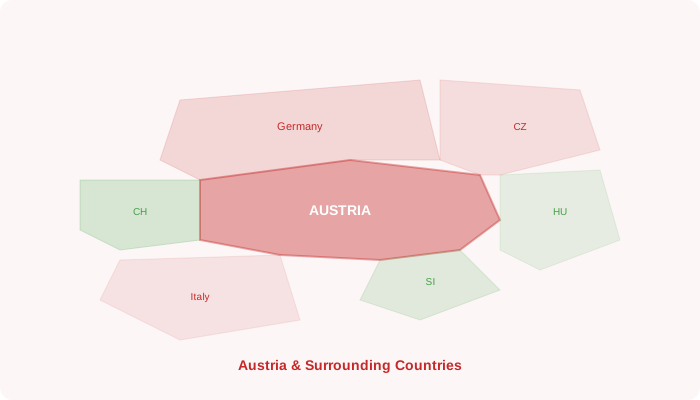
This page provides country-specific information about vignette requirements across Europe. For pricing details, see our Pricing page. For the purchase process, see our Process page. Key terms are defined in our FAQ & Glossary.
Geographic Overview
Austria is centrally located in Europe and borders eight countries: Germany, Czech Republic, Slovakia, Hungary, Slovenia, Italy, Switzerland, and Liechtenstein. Of these neighbours, all except Germany, Italy, and Liechtenstein operate vignette systems. This makes Austria a key transit country for cross-border road trips, and understanding the vignette requirements of neighbouring countries is essential for Austrian-based travellers.
The following sections provide detailed information for each country. For a quick reference, see the Pricing page for a comparative table.
Austria
System type: Digital vignette (e-vignette) since 2023
Operator: ASFINAG
Roads requiring vignette: All motorways (A-roads) and expressways (S-roads)
Roads exempt: Federal roads (B-roads), provincial roads
Local Nuances
- The annual vignette is valid from 1 December of the previous year, allowing early purchase.
- Some motorway sections require additional Streckenmaut (point-to-point tolls) — notably A13, A10, A9, A11, and A14.
- The Grossglockner High Alpine Road and Felbertauern Tunnel are private roads with separate tolls.
- Enforcement is primarily through automatic licence plate recognition cameras.
- Rental cars in Austria often include a vignette — always verify before purchasing.
- The ÖAMTC and ARBÖ automobile clubs are excellent resources for vignette purchase and travel advice.
- Digital vignettes can be purchased up to 18 days in advance with a future start date.
For full details, see our Services page. For pricing, see our Pricing page.
Switzerland
System type: Physical sticker (Vignette/Autobahnvignette)
Operator: Federal Roads Office (FEDRO)
Roads requiring vignette: All national roads (motorways and expressways)
Validity: Annual only (approximately 14 months: December to January)
Local Nuances
- Switzerland only offers an annual vignette — there is no 10-day or monthly option.
- The vignette costs CHF 40 (approximately €40) and is valid for approximately 14 months.
- Physical stickers must be applied to the inside of the windscreen.
- Vignettes are available at Swiss border crossings, petrol stations, and post offices.
- Some Swiss mountain passes and tunnels charge additional tolls (e.g., Great St. Bernard Tunnel).
- Foreign vehicles must purchase a Swiss vignette even for a single crossing of a national road.
- The Swiss vignette is not valid in Liechtenstein, which has its own road system.
Czech Republic
System type: Digital only (e-vignette) since 2021
Operator: State Fund for Transport Infrastructure (SFDI)
Roads requiring vignette: Motorways (D-roads) and some expressways (R-roads)
Local Nuances
- The Czech Republic switched to digital-only vignettes in 2021 — no physical stickers are available.
- Vignettes can be purchased at edalnice.cz, the official website, or at petrol stations.
- Options include 10-day, 30-day, and annual vignettes.
- The D1 motorway (Prague to Brno) is one of the busiest in Central Europe.
- Some expressways in the Czech Republic do not require a vignette — check route-specific requirements.
Slovakia
System type: Digital only (e-vignette)
Operator: National Motorway Company (NDS)
Roads requiring vignette: Motorways (D-roads) and expressways (R-roads)
Local Nuances
- Slovakia offers 1-day, 10-day, 30-day, and annual vignettes.
- Purchase at eznamka.sk or at petrol stations throughout Slovakia.
- The D1 motorway connects Bratislava to Košice and is the main east-west route.
- Bratislava's ring road sections require a vignette.
- Vehicles over 3.5 tonnes use a separate electronic toll system.
Slovenia
System type: Physical sticker
Operator: DARS (Motorway Company of the Republic of Slovenia)
Roads requiring vignette: Motorways (A-roads) and expressways (H-roads)
Local Nuances
- Slovenia still uses physical vignette stickers, available at border crossings and petrol stations.
- Options include 7-day, 1-month, and annual vignettes.
- The Karawanken Tunnel (between Austria and Slovenia) requires separate toll payment from both sides.
- The coastal motorway near Koper is a popular route for travellers heading to Croatia.
- Motorcycles require a separate, lower-priced vignette.
Hungary
System type: Digital only (e-matrica)
Operator: NMHH (National Media and Infocommunications Authority)
Roads requiring vignette: Motorways (M-roads) and some expressways
Local Nuances
- Hungary's e-matrica system is entirely digital — purchase at motorway.hu or at petrol stations.
- Options include 10-day, 1-month, and annual vignettes, as well as county-specific options.
- County vignettes allow use of motorways only in a specific county — useful for short regional trips.
- The M1 motorway connecting Vienna to Budapest is one of the most-used cross-border routes from Austria.
- Vehicles over 3.5 tonnes use a separate HU-GO system.
Other Countries
The following countries also operate vignette systems relevant to travellers from Austria:
| Country | System | Key Notes |
|---|---|---|
| Romania | Digital (rovinieta) | Required on national roads (DN), not just motorways. Multiple validity options. |
| Bulgaria | Digital (e-vignette) | Required on most roads. Purchase at bgtoll.bg or petrol stations. |
| North Macedonia | Physical sticker | Available at border crossings. Annual and short-term options. |
| Moldova | Physical sticker | Available at border crossings. Relatively inexpensive. |
| Bosnia & Herzegovina | Physical sticker | Available at border crossings. Motorway network is limited. |
| Belarus | Physical sticker | Available at border crossings. Note: travel advisories may apply. |
Local Nuances & Tips for Austrian Travellers
- Plan your route in advance: Use a route planner to identify which vignette countries you will pass through and purchase all required vignettes before departure.
- Currency considerations: While most vignettes in the region are priced in Euros, Swiss vignettes are in CHF and Czech/Hungarian vignettes are in local currencies. Budget accordingly.
- Border crossing times: During peak summer months (July–August) and holiday weekends, border crossings can be congested. Purchase vignettes in advance to avoid additional delays.
- Rental cars: If renting a car in Austria for a cross-border trip, confirm with the rental company which countries the car is permitted to enter and whether vignettes are included.
- Insurance: Ensure your vehicle insurance covers all countries on your route. Some policies require additional coverage for certain Eastern European countries.
- Emergency contacts: Save the roadside assistance numbers for each country you will visit. ÖAMTC (+43 120) covers Austria; partner clubs cover neighbouring countries.
- Seasonal roads: Some mountain passes and scenic roads (e.g., Grossglockner) are seasonal and may be closed in winter. Check road conditions before travel.
- Speed limits: Speed limits vary between countries. Austria: 130 km/h motorway, 100 km/h expressway, 50 km/h urban. Switzerland: 120 km/h motorway. Czech Republic: 130 km/h motorway. Always check local rules.